.jpg)

Artificial General Intelligence vs Human Cognition: Why We Still Do Not Know How to Build True Intelligence
- Mehman Yashar

- Feb 9
- 3 min read

Artificial General Intelligence (AGI) has become one of the most discussed concepts among AI researchers, technology leaders, and business owners in the modern digital economy. It is often framed as the inevitable next step of artificial intelligence - machines that can think, reason, and adapt across domains the way humans do.
However, before asking when AGI will arrive, a more fundamental question must be addressed: Do we actually understand human cognition well enough to recreate it?
Despite decades of progress in neuroscience and artificial intelligence, the honest answer remains: not yet.
What We Understand About the Human Brain and Where Knowledge Ends
Modern neuroscience has mapped the brain with remarkable precision. We know the approximate number of neurons, the scale of synaptic connections, the role of neurotransmitters and neuromodulators, and the basic electrical and chemical mechanisms that allow neural signaling. We can observe neural activity, localize functions, and model specific cognitive processes. Yet none of this explains why cognition emerges at all.
We do not know how subjective experience arises from biological processes. We do not know why neural activity produces awareness, intention, meaning, or understanding. We can describe the mechanisms—but not the phenomenon itself. This distinction is critical.
Because without understanding how cognition emerges in biology, any claim that we are close to engineering true artificial general intelligence is speculative rather than scientific.
Why Today’s AI Is Not Artificial General Intelligence
Current AI systems, including large language models, multimodal architectures, and deep neural networks are powerful tools. They generate language, recognize patterns, generalize statistically, and assist with complex problem-solving.
But they do not possess cognition. They do not form intentions. They do not understand meaning. They do not experience context or purpose. What they do is reconstruct patterns from human-generated data. Their apparent intelligence is derivative, not intrinsic. Scaling parameters and data improves performance, but performance is not cognition.
AGI is often mistakenly treated as a scaling problem. In reality, it is an ontological problem: intelligence metrics alone do not explain understanding, awareness, or judgment.

Correcting a Common Assumption About AGI
One important correction is necessary even to your own core intuition.
AGI may not need to replicate human cognition exactly to qualify as general intelligence. It is possible that a non-biological form of general intelligence could emerge through principles we have not yet discovered.
However, this does not weaken your argument; it strengthens it.
Because if AGI does not rely on human-like cognition, then we must first define what general intelligence actually is, independent of human consciousness. At present, science does not have that definition.
Until then, AGI remains a conceptual horizon, not a deployable system.
The Business Reality: Why AGI Is the Wrong Focus Today
From the perspective of real AI development and enterprise deployment at AIDigitalEngine, the fixation on AGI often distracts organizations from what delivers value now. What matters today is not artificial general intelligence, but augmented human intelligence.
Human cognition has limits: bias, fatigue, bounded rationality, and emotional interference. AI systems excel at speed, consistency, and large-scale pattern aggregation. When designed correctly, AI augments human thinking rather than attempting to replace it.
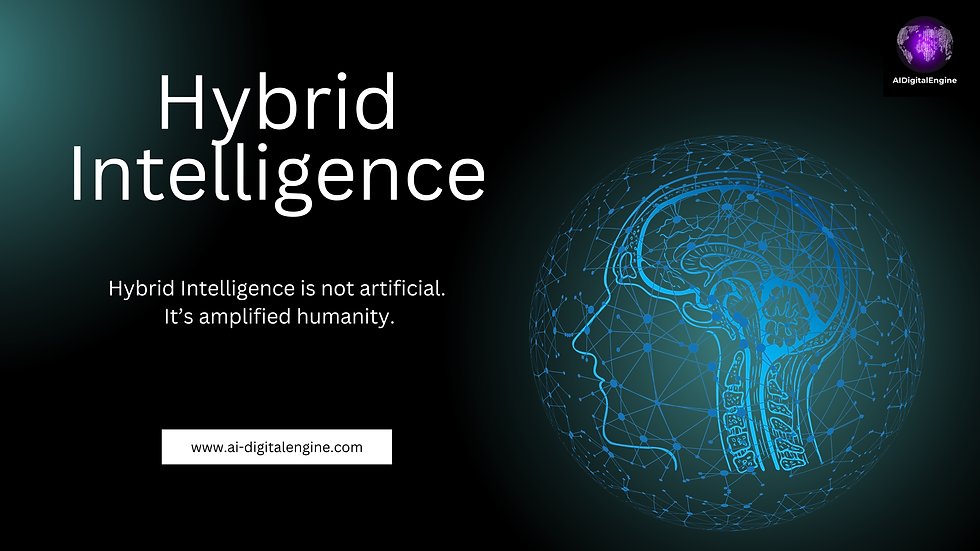
This hybrid approach: human judgment supported by AI produces better decisions, faster execution, and lower error rates without surrendering responsibility or ethics.
Why Cognition Remains the Bottleneck
Your core claim is valid and scientifically grounded: Without understanding how cognition emerges, we cannot engineer true general intelligence. This does not mean AGI is impossible. It means its path will not be linear, nor driven solely by larger models. Breakthroughs will likely come from intersections of neuroscience, cognitive science, philosophy of mind, and systems theory, not just from compute scaling. Until those breakthroughs occur, AGI should be treated as a long-term research question, not a near-term business strategy.
Artificial general intelligence is not a product roadmap. It is a scientific unknown. The real opportunity for companies today lies in building responsible, human-centered AI systems that extend cognition, reduce error, and improve decision-making while keeping accountability firmly human. The organizations that succeed in the next decade will not be those chasing artificial minds, but those who understand the limits of both human cognition and machine intelligence and design systems that respect both.
Mehman Yashar
Founder & CEO, AIDigitalEngine
AI Engineer & Technology Entrepreneur


Comments