.jpg)

AI vs Human Decision-Making: Similarities, Differences, and the Real Future of Judgment
- Mehman Yashar

- Feb 11
- 5 min read
Updated: Feb 12

Why do so many people assume that artificial intelligence must be built on top of human cognition to become “real” intelligence? It is an understandable assumption: human intelligence is the only example we know from the inside. But it may also be limiting. A more accurate way to frame the question is this: what if AI is not a copy of human cognition but a different type of intelligence, one that emerges alongside human intelligence, shaped by different constraints, different “bodies,” and different goals?
To discuss AI versus human decision-making honestly, we must start with a humbling fact about ourselves. Neuroscience has mapped an enormous amount of the brain’s structure and mechanics: neurons, synapses, neurotransmitters, neuromodulators, and large-scale functional networks. Yet despite these advances, science still struggles to explain why biological activity gives rise to cognition, meaning, subjective experience, and the feeling of understanding. That gap matters because it exposes something deeper: we can model mechanisms without fully explaining emergence.
And that is where the AI comparison gets interesting.
A correction to a common idea: AI vs Human Decision Making is not “emergence” in the same way human cognition is
An intuition about emergence is strong, but one key distinction is important. Human cognition appears as an emergent phenomenon from biological processes that evolution shaped over millions of years. AI, in contrast, does not spontaneously emerge from code in the same sense. AI is engineered: trained to optimize objectives and shaped by data, architectures, and human-designed evaluation loops.
However, there is a meaningful parallel: modern AI systems often exhibit emergent behaviors that were not explicitly programmed. This is one reason interpretability and safety research exist because even when we know the code and training method, we still do not fully understand why complex neural networks form certain internal representations or behaviors. Research communities and labs are actively working to “look inside” models and map their internal concepts, precisely because parts of their behavior remain difficult to explain mechanistically.
So the cleaner, more accurate claim is this: we understand AI’s training mechanics far better than we understand cognition, yet AI can still be opaque in practice. “We know the code” is true, but “we fully understand why it behaves like this” is often not.
Human decision-making: powerful, adaptive, and biased by design
Human judgment is not a purely logical engine. It is adaptive intelligence built for survival under uncertainty. Humans make decisions using fast heuristics, emotional signals, social awareness, memory shortcuts, and context. This is why humans can generalize across new domains quickly, but also why we fall into predictable cognitive traps.
Behavioral science has shown that humans rely on quick, intuitive processing for many decisions, and this can systematically produce bias and error, especially when time, stress, or information overload is present.
This is not a moral flaw. It is a design trade-off.
AI decision-making: not judgment, but statistical inference and optimization
AI systems do not “judge” in the human sense. They infer patterns and optimize outputs relative to an objective function, using the data and constraints they were given. That can look like reasoning, and in narrow domains it can outperform humans, but it is not the same cognitive process.
This distinction matters because it changes what AI is good for.
AI is strongest when decision-making can be framed as pattern recognition, classification, prediction, ranking, anomaly detection, or constrained optimization. AI struggles when the decision depends on lived experience, moral responsibility, shifting goals, ambiguous definitions of success, or values.
Similarities between AI and humans in decision-making
The similarity is not that AI thinks like the brain. The similarity is that both humans and AI can produce systematic bias and both can produce confident errors.
Humans carry bias through psychology and social learning. AI inherits bias through data, objectives, and selection effects. A major body of research has documented how algorithmic systems can inherit and reproduce societal bias because data often reflects historical patterns and prior human decisions.
So the shared point is this: neither humans nor AI are automatically neutral. Decision-making is always shaped by the system that produces it.
How does AI augment human decision-making?
When designed responsibly, AI can reduce cognitive load and improve consistency. It can surface correlations humans miss, detect early signals, and provide decision support, especially in complex, data-heavy environments.
This is why you see AI used in forecasting, diagnostics support, fraud detection, risk scoring, operations planning, and quality control. In these scenarios, AI is not the “final judge.” It is an intelligent instrument that expands the human decision-maker’s visibility.
At AIDigitalEngine, this is the practical philosophy we use: AI should support human judgment, not replace it, especially in high-stakes contexts.

How AI interferes with human judgment: automation bias and algorithm aversion
Here is the risk most businesses underestimate: the biggest danger is not AI being wrong. It is humans reacting to AI in predictable ways.
One well-studied phenomenon is automation bias - the tendency to over-rely on automated recommendations even when contradictory information exists. This has been documented across domains and reviewed in research literature.
The opposite pattern also exists: algorithm aversion - people may reject an algorithm after seeing it make a mistake, even when it outperforms humans overall.
This creates a real-world paradox for businesses: if teams trust AI too much, they stop thinking. If they distrust it too quickly, they never adopt it long enough to extract value. The solution is not “more AI.” The solution is better human-AI interaction design, clearer accountability, calibrated confidence indicators, and governance.
Can AI be a different kind of intelligence?
Yes - AI can be viewed as a different kind of intelligence, but not in a mystical way. AI intelligence is “non-biological competence” under defined objectives. Human intelligence is biological cognition with meaning, intent, emotion, and accountability.
They can be structurally different at the base level, and they are. But that does not reduce AI’s usefulness. It clarifies its purpose.
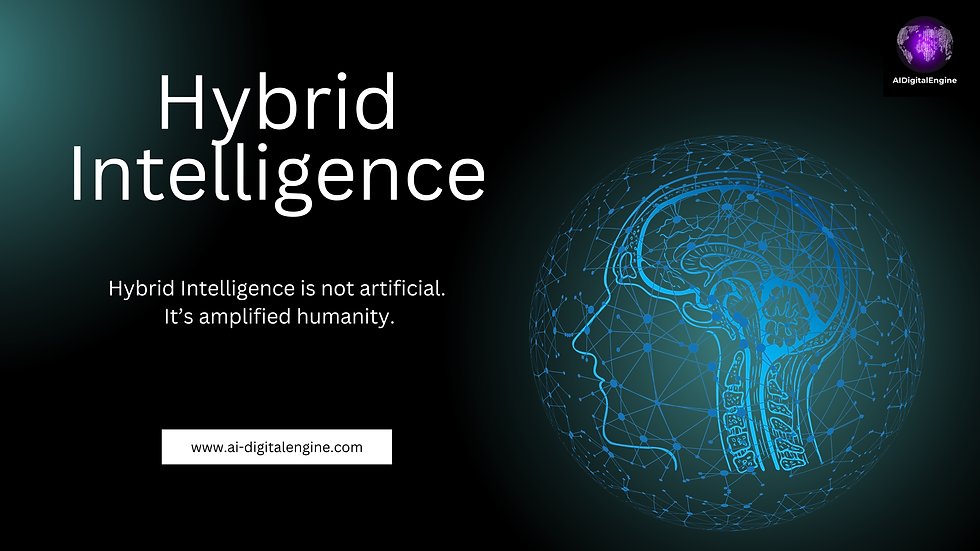
The future is not AI becoming human. The future is humans learning to build hybrid decision systems: human values and responsibility, supported by machine-scale pattern detection.
The only way “one system” works: governance and fair observation
Hybrid systems require oversight. If humans design oversight poorly, bias returns. If oversight is delegated blindly to AI, responsibility disappears.
In practice, the solution is layered: transparent data practices, bias testing, monitoring in production, human-in-the-loop controls, and clear ownership of outcomes. This is where serious AI development separates itself from hype.
Hybrid decision-making systems can increase speed and reduce mechanical errors, but they must be governed, audited, and aligned with real-world goals, not just internal metrics.
AI is not “pure logic.” Humans are not “pure bias.” Both systems produce outcomes shaped by their constraints. The real competitive advantage comes from designing decision-making systems that are faster, more accountable, and more transparent than either humans or AI alone.
That is the opportunity for modern leaders and companies: not to chase artificial minds, but to build intelligent infrastructure that improves judgment without replacing responsibility.
AI Engineer & Technology Entrepreneur


Comments